
Archive footage in minutes, not half-hours
For public and private broadcasters, news agencies and publishers with video desks: moment search across decades of material — with dialect recognition and rights information right on the result.
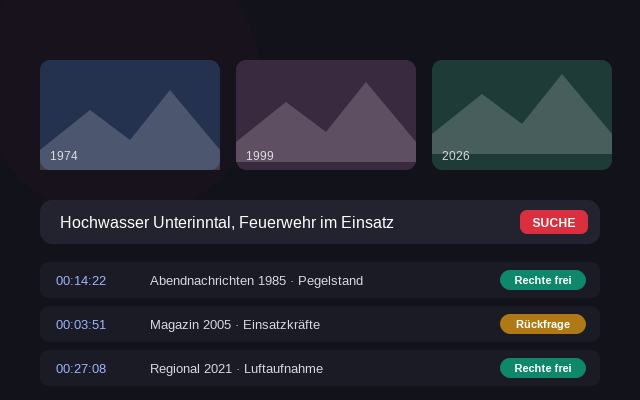
The shot, before the copy is finished
Breaking news at 11:40 pm: VideoFinder returns time ranges instead of whole items, with previews and colour-coded rights. Archive teams are freed from routine requests and focus on what machines cannot do.
- Speech incl. dialect, lower thirds, on-screen text
- Scenes, places and objects — ‘helicopter over flooding’
- Rights status from your MAM: cleared, ask first, blocked
- Faces only from your own curated list of public figures
What you get, specifically
Dialect models
Adapted with your corrected transcripts — for Tyrolean, Styrian, Bavarian or Swiss German.
On-premises index
On the Broadcast plan, the search index can run in your data centre. Updates arrive signed; data never leaves the building.
REST API & webhooks
Search directly from your media asset management, newsroom system or edit suite.
Archive insights
Which collections are searched but not found? Prioritise digitisation and rights clearance accordingly.
Rights first
Blocked material is never offered for use. Licence expiry is shown on the result.
Formats
MXF, MOV, MP4, audio archives; metadata import from EBUCore and CSV exports of legacy databases.
In breaking news every minute counts. Archive research used to take half an hour; now the desk editor has the footage before the copy is finished.Andreas Rainer, Head of Archive & Documentation, Rundfunk Ostalpen
Frequently asked questions
How long does indexing a large archive take?
Does VideoFinder replace our MAM?
How do you handle face recognition?
Show us your archive — we will show you the moments inside it.
In a 45-minute demo we can index one of your own recordings in advance. No obligation, in German or English, in Vienna or online.