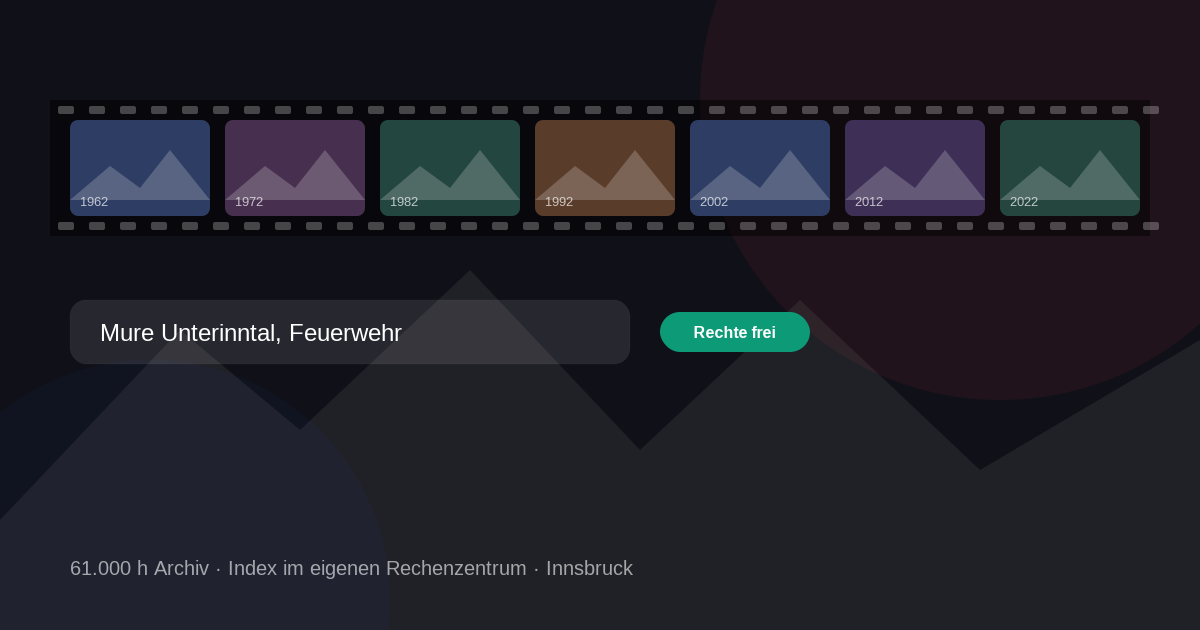
VideoFinder Forum DACH 2027 · 25 February, Vienna — Save your seatEducation & broadcast · Austria · Germany · Switzerland
SolutionsCase studiesPricingSecurityEventsAboutCareersContactBook a demo
VideoFinder for Education & Broadcast · DACH

Find the moment, not just the file.

VideoFinder makes lecture recordings, broadcast archives and media libraries searchable by what is said, shown and displayed in them — down to the second, dialect included.
GDPR & DPA under Art. 28Hosted in Vienna & FrankfurtGerman (AT/CH/Bavarian)
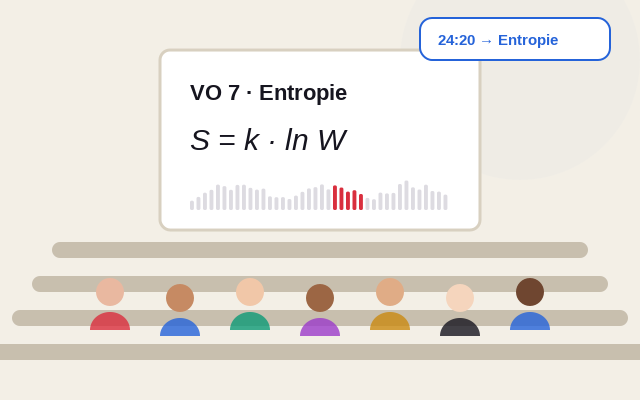
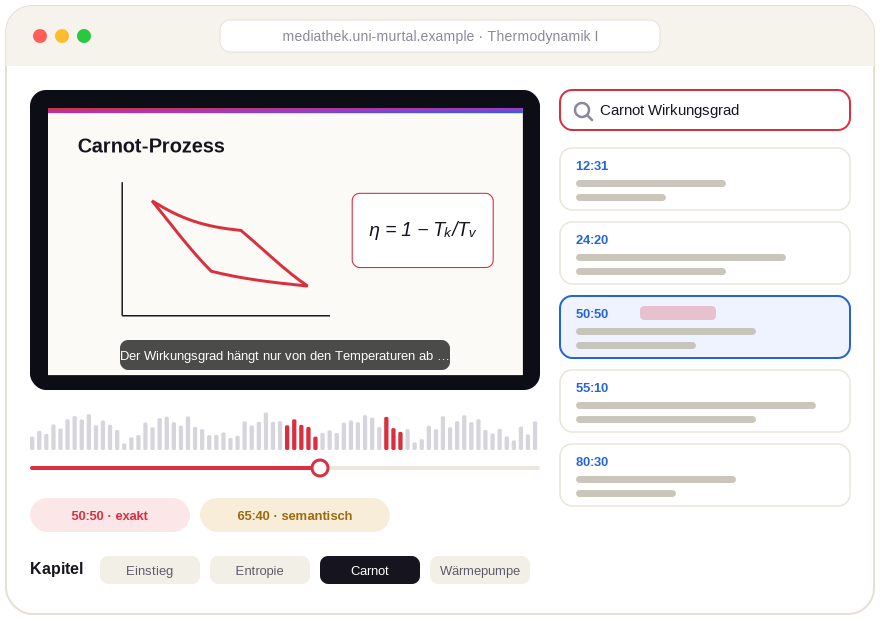
VideoFinder interface: lecture video with transcript, timeline hits and chapters
23 hits in 14,200 hmedian response 41 ms
Automatic captionsWER 7.8% in technical lectures

Used by universities, broadcasters, newsrooms and media libraries in Austria, Germany and Switzerland
Universität Murtal
Rundfunk Ostalpen
Bildungsmedien Limmat-Aare
Hochschule Leithaberg
Isarwerk Medienhaus
Morgenpost Salzach
Pädagogische Hochschule Wienerwald
Stadtarchiv Donaustein
Live demo

Try it: one lecture, 88 minutes

Search the transcript of a (fictional) thermodynamics lecture. Amber hits come from semantic search — the word itself does not appear there.
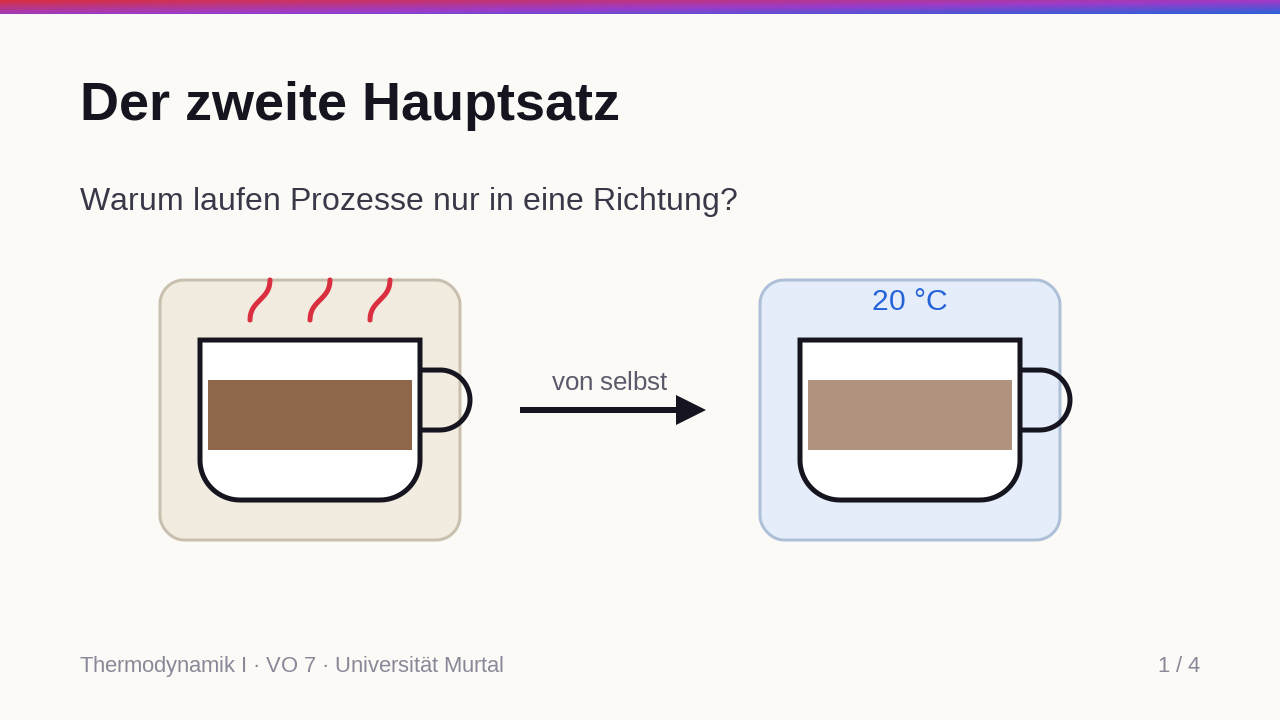
Lecture slideREC · LECTURE 7
Good morning! Today is about the second law — in other words, why coffee cools down on its own but never heats up again on its own.
0:00 / 1:28:40
Thermodynamics I · Lecture 7: The second lawIntro & recap
Universität Murtal · Prof. Martin Ebenhofer · Winter term 2026/27Preview at 50× speed
Type a term — or try a suggestion
  • Prof. EbenhoferGood morning! Today is about the second law — in other words, why coffee cools down on its own but never heats up again on its own.
  • Prof. EbenhoferQuick recap: the first law only says that energy is conserved. It says nothing about the direction of a process.
  • StudentDoes that mean a process could in theory run backwards, as long as the energy adds up?
  • Prof. EbenhoferThat is exactly the question the second law answers — and the answer is: in practice, no. Natural processes are irreversible.
  • Prof. EbenhoferThink of two gases mixing. Nobody has ever seen them separate again of their own accord.
  • Prof. EbenhoferTo quantify that, we introduce a new state variable: entropy, symbol S, measured in joules per kelvin.
  • Prof. EbenhoferIntuitively, entropy measures how many microstates fit a macrostate. Boltzmann had it engraved on his tombstone: S equals k times the log of W.
  • Prof. EbenhoferBy the way, that tombstone is in Vienna’s Central Cemetery — worth a visit if you are ever there.
  • Prof. EbenhoferImportant: the total entropy of an isolated system never decreases. In the ideal case it stays the same; otherwise it grows.
  • StudentSo why do people say entropy is simply disorder?
  • Prof. EbenhoferBecause ‘disorder’ is a useful picture but not an exact one. A tidy desk does not really have fewer microstates.
  • Prof. EbenhoferLet us move on to the most important machine of this course: the Carnot cycle. Two isotherms, two adiabats, all reversible.
  • Prof. EbenhoferThe efficiency depends only on the two temperatures: one minus T cold over T hot. In kelvin, please — that is the most common source of errors.
  • Prof. EbenhoferWorked example: a power plant operates between 820 and 300 kelvin. The theoretical upper limit is then about 63 percent.
  • StudentBut real power plants achieve much less, don’t they?
  • Prof. EbenhoferRight, more like 40 to 45 percent. Friction, heat losses, finite speeds — all irreversible contributions.
  • Prof. EbenhoferRemember: no engine operating between the same temperatures can be more efficient than the Carnot engine.
  • Prof. EbenhoferNow we run the process in reverse. Then we get a heat pump or a refrigerator — depending on which side we care about.
  • Prof. EbenhoferFor a heat pump we do not talk about efficiency but about the coefficient of performance. It can be well above one.
  • StudentWill that come up in the exam like on problem sheet five?
  • Prof. EbenhoferSimilar. For the exam: you should be able to derive the Carnot efficiency and the coefficient of performance without a formula sheet.
  • Prof. EbenhoferAs always, the slides and this recording are in the Moodle course. Next week: cycles in practice.

The demo runs entirely in your browser. Nothing you type is transmitted.

How it works

From recording to result in four steps

01

Connect

Lecture capture, MAM, media library or just an upload folder: we pick up videos where they already live.

02

Index

Speech, slides, on-screen text, scenes and objects — every two seconds, in data centres in Vienna and Frankfurt.

03

Search

Exact or semantic: ‘disorder’ also finds ‘entropy’. Results with timestamps and previews.

04

Share

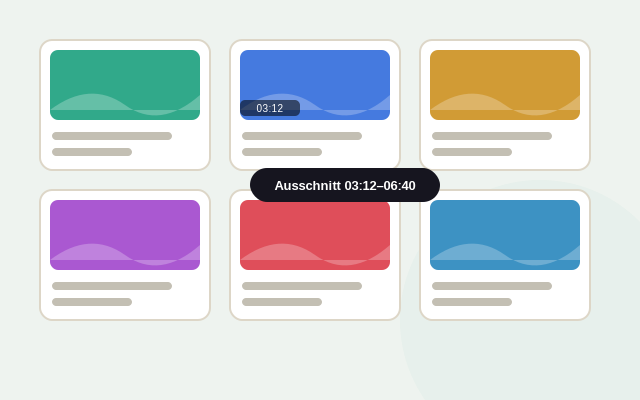
Clips, chapters and captions straight into the LMS, the edit suite or as a link.

212.000 hvideo indexed across DACH
34institutions in AT, DE and CH
41 msmedian search time across archives
25 minuntil a new lecture is searchable
What customers say

Less searching, more teaching and reporting

“Our students no longer look for ‘lecture 7, somewhere in the middle’ — they search ‘Carnot efficiency example’ and land on the exact second.”
Dr. Verena KoglerHead of the Centre for Digital Teaching, Universität Murtal
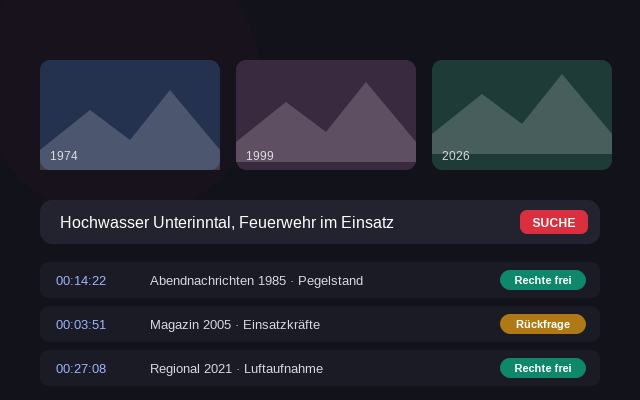
“In breaking news every minute counts. Archive research used to take half an hour; now the desk editor has the footage before the copy is finished.”

Andreas RainerHead of Archive & Documentation, Rundfunk Ostalpen
“Teachers now find the three minutes they need in our media library — even in dialect interviews nobody had ever tagged.”
Corinne BaumgartnerManaging Director, Bildungsmedien Limmat-Aare
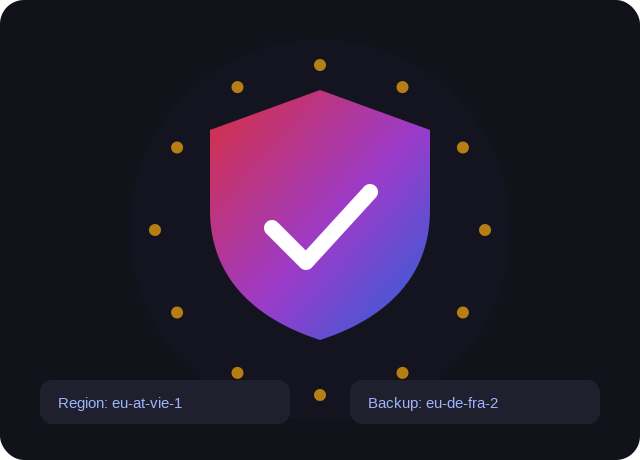
Shield icon with data centre regions Vienna and Frankfurt
Security & privacy

Your data stays in the EU. Full stop.

Lectures contain students’ voices, archives contain unpublished material. That is why we process exclusively on our own systems in Vienna and Frankfurt am Main — with no transfers to third countries.

  • Data processing agreement under Art. 28 GDPR
  • Your content is never used to train general models
  • ISO/IEC 27001: certification in preparation, audit planned for Q2 2027
  • SSO via SAML 2.0, roles per course, desk or collection
Security & compliance →
Events

Meet us in Vienna, Graz, Zurich and Munich

Breakfasts, workshops and webinars from November to March. Free, with limited seats.

All dates →
Dec32026
OnlineWebinarDE

Webinar: GDPR & video archives — what universities should check now

Thursday, 3 December 202611:00–12:00 CET
Dec102026
GrazWorkshopDE

Workshop: lecture-video workflow with Moodle and LTI 1.3

Thursday, 10 December 202613:00–17:00 CET
Jan212027
MunichRoundtableDE

Newsroom roundtable: archive footage in breaking news

Thursday, 21 January 202717:30–20:00 CET

Show us your archive — we will show you the moments inside it.

In a 45-minute demo we can index one of your own recordings in advance. No obligation, in German or English, in Vienna or online.